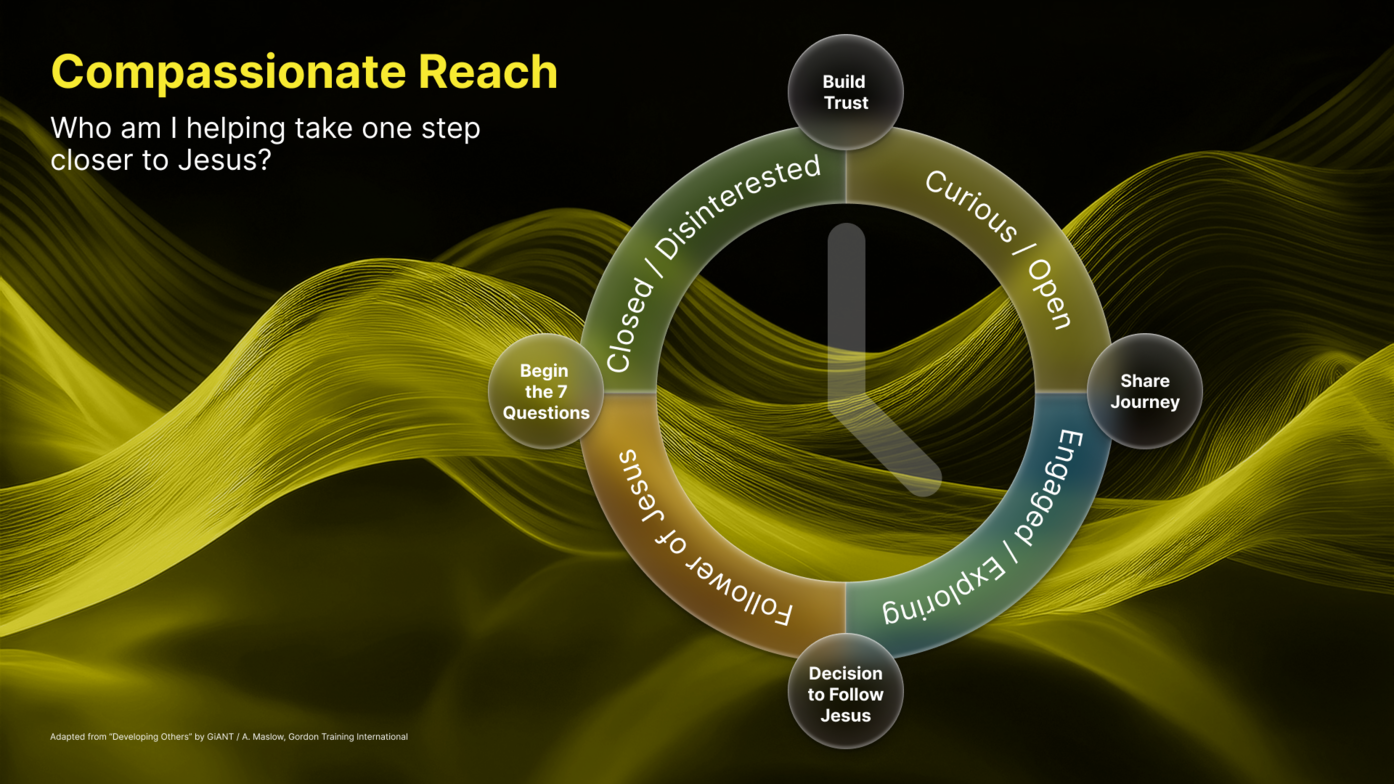
In our busy lives, it's easy to get caught up in our own spiritual journey and forget about those around us who may be searching for meaning, hope, or truth. But what if we shifted our perspective and asked ourselves a simple yet profound question: "Who am I helping take one step closer to Jesus?"
The Heart of Jesus is Compassionate Reach
When we look at the life of Jesus, we see a pattern of compassionate reach. In Matthew 9, we read that "when he saw the crowds, he had compassion for them because they were harassed and helpless, like sheep without a shepherd." What moved Jesus wasn't annoyance or frustration with people's spiritual condition—it was compassion.
What Does Compassion Really Mean?
Compassion isn't just a feeling; it's an action. It means your heart moves toward someone's need rather than away from it. True compassion requires us to step forward, not step back. It's about kindness, mercy, empathy, love, grace, and understanding—all active words that demand response.
Immediately after describing Jesus' compassion, Matthew records these words: "The harvest is plentiful, but the workers are few." There are people ready, people open, and people searching, but someone has to step toward them.
One Step Matters More Than You Think
Sometimes we hesitate to reach out because we think we're responsible for someone's entire spiritual transformation. But Scripture paints a different picture. Paul writes in 1 Corinthians 3: "I planted, Apollos watered, but God gave the growth."
You're Not Responsible for Conversion
You're not responsible for someone's salvation—you're responsible to be obedient and take one step. The question isn't "Who am I converting?" but rather "Who am I helping take one step closer to Jesus?"
What might that one step look like? It could be:
-
Listening to doubts without panicking
-
Praying for them consistently
-
Inviting them to church
-
Sharing your testimony
-
Serving them when they least expect it
When Jesus encountered Zacchaeus in the tree, He didn't give him a theological lecture. Instead, He said, "Zacchaeus, hurry and come down, for I must stay at your house today." Sometimes the first step toward Jesus is simply hospitality and presence.
Compassion Requires Proximity
You can't reach people you refuse to be near. Jesus was known for His proximity—He ate with tax collectors, touched lepers, defended sinners, and slowed down in busy crowds for interruptions.
Are You Present in People's Lives?
Luke 15 tells us that "all the tax collectors and sinners were coming near to listen to him." Why were they drawn to Jesus? Perhaps because they sensed compassion before correction.
Ask yourself these honest questions:
-
Do the people in your everyday life know that you follow Jesus?
-
Do they experience you as gracious?
-
Do they feel safe asking you spiritual questions?
-
Are they safe with you?
Compassionate reach doesn't have to be loud, but it does have to be consistent. It's about kindness over time, integrity under pressure over time, and hope in difficulty over time.
We Reach Because We Were Reached
Our motivation for reaching others comes from remembering our own story. Ephesians 2 reminds us: "But God, who is rich in mercy, out of the great love with which he loved us, even when we were dead through our trespasses, made us alive together with Christ.
Someone Reached You First
You were once spiritually distant, unaware, or resistant. Yet you're here today because someone practiced compassionate reach toward you. Someone prayed for you, invited you, spoke truth to you, and modeled faith for you.
When we truly grasp that Jesus stepped toward us, we can't help but step toward others. This isn't about guilt or pressure—it's about gratitude for what has been done for us.
Compassionate Reach is Not a Program—It's a Posture
Compassionate reach isn't just another church program; it's the posture of the church. It's who we are to be and how we are to live in our everyday interactions outside the church walls.
People should be able to say about us: "They invited me, they made me feel welcome before I ever got to the parking lot, they've been praying for me, they spoke truth to me." Now it's your turn to be that someone for others.
Life Application
This week, commit to three specific actions that embody compassionate reach:
- Pray for One: Ask the Holy Spirit to place one specific person on your heart. Not a category or group, but one name. Pray for their heart to be open, for opportunities to love them well, and for courage and wisdom in yourself. Write their name somewhere visible so you're reminded to pray for them daily.
- Step Toward One: Take one intentional relational step toward that person or someone else. Don't overcomplicate it—invite them to coffee, send an encouraging text, ask a deeper question, offer to pray for something they're facing, or invite them to church. Remember, your goal isn't to convert in that moment but to converse and help them take one step closer to Jesus.
- Share with One: Be ready to share one piece of your story about how Jesus has changed you, how you've experienced His faithfulness, or what He's teaching you right now. It doesn't have to be polished or long—authenticity often reaches further than perfection. People are rarely argued into the kingdom, but they are loved into it.
Questions for Reflection:
-
Who has God placed in my life that needs to experience His love through me?
-
What's holding me back from taking that one step toward someone who needs Jesus?
-
How can I better reflect the compassion of Jesus in my daily interactions?
-
What part of my story could encourage someone else in their spiritual journey?
Don't measure success by the outcome—measure it by obedience. You're not responsible for saving anybody, but you are responsible for loving somebody. When we live this way, with compassion moving outward one step at a time, God will do more than we could ever imagine.